The Radius of Dust
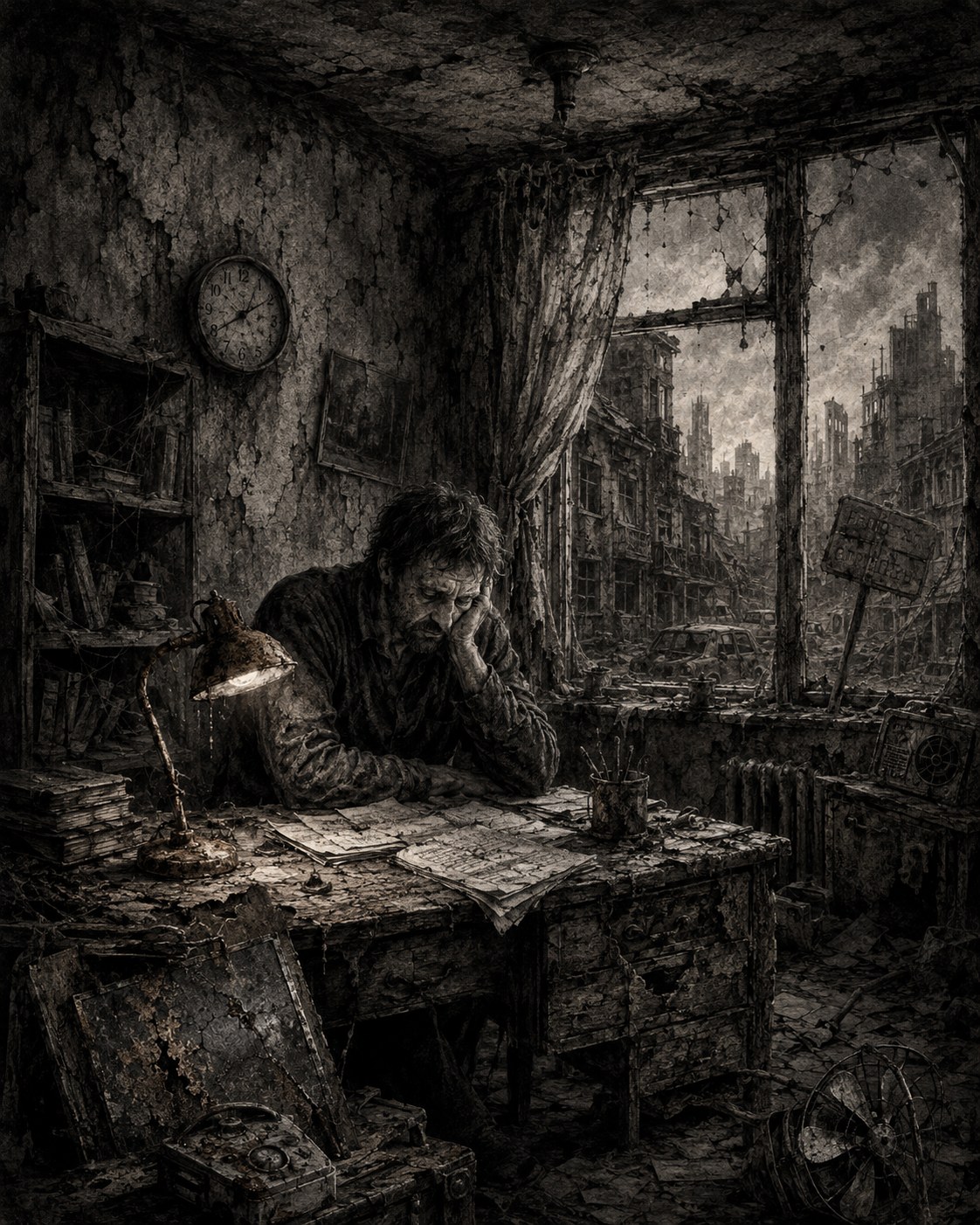
THIS IS A WORK OF FICTION
The first thing to die was the rubber band around the bread packet.
It snapped in Anirban’s hand at six in the morning, not with the brisk little ping of a healthy rubber band, but with a tired sigh, as if it had been holding together not four slices of milk bread but the British Empire. The bread inside was gray at the edges. Yesterday evening it had been soft and square and ordinary, bought from the bakery under the peeling blue awning near Kalighat tram depot, where buses coughed black smoke into the faces of pedestrians and a tea seller named Nagen shouted, “Dada, cha?” with the optimism of a man who had seen every government fail and still believed in boiling water.
Anirban stood by the window of his rented flat and pressed the bread with his thumb. It collapsed into powder.
Below, Balaram Bose Lane was waking in its usual battered orchestra. A fish seller slapped katla onto a wooden board. Someone’s pressure cooker screamed as if accused unjustly. A tram wire hummed above the road, thin and stubborn as an old aunt’s opinion. Posters of coaching centers and political promises blistered on the walls. A taxi reversed into a drain cover with a clang. Two schoolboys argued over whether their private tutor smelled of paan or history. Calcutta, even half-asleep, had no talent for silence.
Anirban had once loved that.
Now the sounds arrived through him like rain through a leaking roof.
He was forty-eight, thin in the way of men who forgot lunch and then resented dinner for existing. He earned uncertain money proofreading Bengali textbooks for a small publisher in College Street, mostly correcting other people’s mistakes while preserving their confidence. He had a habit of apologizing to chairs when he bumped into them. He had a face that made neighbors say, “You look tired,” with the satisfied horror of people who had discovered a small corpse in the stairwell.
On the table lay three unpaid bills, one letter from the landlord, and his mother’s brass key-ring, which he had still not put away though she had been dead for eleven months.
He threw the ruined bread into the bin. The bin liner tore. A dry smell rose from it, not rotten exactly, but old: dust, abandoned wardrobes, shut classrooms after summer vacation.
“Excellent,” he said aloud. “Even bread has retired before me.”
The second thing was the pencil.
By noon, while he sat at his desk marking commas in a grammar guide for Class Seven, his pencil shortened in his fingers. Not broke. Shortened. The yellow paint dulled, cracked into little scales, and fell. The wood beneath turned fibrous. The graphite slid out like a black bone and rolled across the page.
Anirban stared at it.
The sentence under correction read: The cow is a useful animal.
He laughed once. It came out badly.
The laugh frightened him more than the pencil.
He had been warned about moods. Not by doctors alone, though he had collected enough consultations to make a respectable footpath library, but by relatives, neighbors, acquaintances, and one grocer who believed sadness could be cured by walking briskly before sunrise. Everyone in Bengal was a psychiatrist after tea. The country had converted suffering into advice and advice into a renewable energy source.
“Don’t stay alone so much,” his cousin Mili had said the previous week, sitting on his cane chair with her handbag clutched against her stomach as if the flat might pickpocket her. “Come to our place for a few days.”
“I’ll spoil your sofa.”
“You’ll spoil your liver if you don’t eat.”
“My liver and I are no longer speaking.”
She had tried to smile. Mili was five years younger, a schoolteacher in Behala, brisk, kind, and permanently tired from being the only competent person in a family of sentimental ruins. She had arranged his mother’s shraddha, argued with the priest, paid the caterer when Anirban found himself unable to count notes, and had since been trying to drag him back into ordinary life as one might coax a cat out from under a car.
“You still haven’t opened Mashima’s trunk,” she had said.
“No.”
“There may be papers.”
“There may be ghosts.”
“Don’t be clever. Cleverness is not food.”
He had promised her he would open it. He had not.
His mother’s trunk sat in the corner of the bedroom beneath a faded sheet. Metal, green, dented, smelling faintly of naphthalene and coconut oil. She had brought it from her father’s house after marriage. In the last months, when illness made her suspicious of everyone except the ceiling fan, she had kept it locked and the key under her pillow. After she died, Anirban found the brass key-ring in the pillowcase, warm from the last feverish shape of her head.
He put the ruined pencil beside the ruined bread.
By evening, the desk began.
It was an old teak desk his father had bought from a retiring barrister in Bhowanipore, back when secondhand furniture was not “vintage” but evidence that one was making do. Its surface held the pale rings of teacups, ink stains, a burn mark from a mosquito coil, and a scratch shaped like the Hooghly. Anirban had studied on it for exams, written college applications, filled job forms, translated medical pamphlets for money, and once slept on it during a power cut because the floor was flooded.
At seven, while rain gathered itself over the city, he heard a soft chewing.
He looked down.
Tiny holes opened along the desk’s front edge. Not termite holes. Larger, wetter. The wood darkened, sagged, and exhaled a smell of pond water and old sorrow. A drawer handle loosened. One leg bent inward as if ashamed of standing.
Anirban got up so fast the chair fell behind him.
“Enough,” he said.
The desk settled another inch. The papers slid toward him in a small white landslide.
Outside, thunder rolled over the tramlines. The lights flickered. In the pause between electricity and darkness, he saw his reflection in the window: unshaven, hollow-eyed, one hand holding the dead pencil like evidence at a trial.
Someone knocked.
He did not answer.
“Anirban-babu?” called Nirmal-da, the landlord from downstairs. “You are at home? Water is coming through our ceiling.”
Anirban looked up.
A brown stain spread across the plaster above the desk. The fan turned slowly, its blades furred with dust that had not been there in the morning. The paint around the stain cracked, curled outward, and fell in soft flakes.
Another knock.
“Anirban-babu? Open once.”
He opened.
Nirmal-da stood in the corridor wearing a sleeveless vest and the expression of a man balancing civility against rent. He was in his sixties, with oiled hair, a small towel around his neck, and a belly shaped by rice, worry, and inherited property. Behind him, the stairwell smelled of damp cement and frying onions.
“What have you done?” Nirmal-da said, peering past him. “Pipe burst?”
“No.”
“No means what no? My ceiling is crying.”
“That may be independent.”
“Independent! Listen to him. Are you conducting monsoon in your room?”
He stepped inside before Anirban could stop him. His eyes moved from the desk to the ceiling to the bread dust in the bin. For a second, landlord and tenant stood together in the dim room while the flat made a sound like an elderly person turning in bed.
Nirmal-da’s irritation faltered.
“This desk was good wood,” he said quietly.
“Yes.”
“You should not let things go like this.”
Anirban almost said, I didn’t.
Instead he said, “I’ll pay for repairs.”
“With what? Poetry?”
It should have been funny. Nirmal-da often said such things. In Calcutta, insult was the last affordable luxury. But the words landed with unbearable accuracy.
Anirban’s throat tightened. He felt the familiar descent begin: the inner weather, the black barometer dropping. It was not sadness, not exactly. Sadness had a shape, a reason, a chair to sit on. This was vacancy with teeth. It entered behind the eyes, behind the ribs, and informed every cell that the world had been canceled for lack of interest.
The room responded.
The bookshelf groaned.
One by one, the spines of his books faded. Red became liver-brown. Blue became ash. Pages yellowed, curled, then crisped at the corners. A dictionary split down the middle. A volume of Tagore shed its cover in a papery shrug. The calendar on the wall advanced through months in a flutter, then stopped at a blank square.
Nirmal-da backed toward the door.
“Baba re,” he whispered.
The electric bulb dimmed, its glass clouding from within.
“Please leave,” Anirban said.
Nirmal-da did. On the threshold he turned, wanting perhaps to scold, perhaps to bless, perhaps to ask for rent. None of these seemed equal to the moment.
He ran downstairs.
By morning, the flat was old.
Not merely dirty. Old.
The curtains hung in strips. The mirror had silvered over until his face appeared drowned beneath it. The plastic bucket in the bathroom became brittle and split when he touched it. The tap coughed rust-colored water, then dust. The bedsheet had thinned into something like hospital gauze. The walls sweated brown streaks. Even the steel plates in the kitchen had lost their shine and taken on a dull, pitted fatigue.
Anirban walked from room to room with the care of a burglar in a museum.
He did not feel panic. Panic required energy. He felt a terrible politeness toward catastrophe, as if the flat had become an old relative and he must not embarrass it by noticing the smell.
At nine, Mili arrived.
She carried bananas, muri, and a packet of glucose biscuits, because Bengali love often came wrapped in edible pessimism. She stopped at the doorway.
“What happened?”
“I became very sad,” Anirban said.
“Don’t talk rubbish.”
“I’m not.”
She entered, pressing her sari to her nose.
The cane chair collapsed before she reached it.
Mili did not scream. She had taught adolescents for twenty years and had therefore seen civilization fail in slower, more grammatical forms. She placed the food on the floor and looked at him.
“Come with me.”
“I can’t.”
“You can walk.”
“That’s not the same thing.”
She glanced toward the bedroom. “Open the trunk.”
“No.”
“Then I will.”
He moved between her and the door.
It surprised them both.
For a moment they were children again in his mother’s kitchen, fighting over the last luchi, his mother laughing from the stove. Then Mili’s face hardened.
“What are you hiding?”
“Nothing.”
“Then why are you guarding it like a zamindar’s illegitimate child?”
He almost smiled.
The ceiling above them cracked.
A long line raced from the fan to the wall, then branched toward the bedroom. Dust fell in a soft rain onto Mili’s hair. She looked up.
The house shuddered.
From downstairs came Nirmal-da’s wife shouting, “The almirah! The almirah door fell!”
In the lane, a scooter alarm began to bleat and then died mid-cry. A window frame across the courtyard dropped from its hinges. Somewhere a glass bottle burst.
Mili gripped Anirban’s arm.
“What is this?”
“I think it’s me.”
“No. Don’t give yourself such importance.”
“It happens when I sink.”
“Then don’t sink.”
He laughed again, worse than before. “Brilliant. You missed your calling in medicine.”
She slapped him.
Not hard. Enough.
He stared at her.
Mili’s eyes filled, but she did not apologize. “You think grief makes you special? Everyone is carrying something. Some carry it to office, some to the fish market, some to tuition, some to bed. You are not a black hole, Anirban-da.”
At that, the floor under the desk sagged with a deep wooden complaint.
Mili heard it. Her face changed.
“Open the trunk,” she said again, softer. “Your mother asked me not to tell you unless this started.”
The room stopped.
Even the rain seemed to pause on the window bars.
“What started?”
Mili swallowed. “Things going old.”
“You knew?”
“I knew a story. I thought it was fever nonsense.”
“What story?”
“She said your father’s death was not an accident.”
Anirban sat on the edge of the bed. The mattress released a puff of dust around him.
His father had died when Anirban was twelve. A shelf had fallen in the storeroom during a storm, crushing his chest. That was the official version, family version, neighborhood version, the version served with tea and sympathy until it became indistinguishable from truth.
Mili looked toward the covered trunk.
“She said the house took him because it had already taken too much from other things.”
“House?”
“I don’t know.”
Anirban stood.
The key-ring lay on the desk, darkened now, the brass gone nearly black. He picked it up. The keys were colder than they should have been.
The trunk’s sheet crumbled when he pulled it away.
He knelt before the lock. For a moment he was certain he heard his mother breathing on the other side. That small, irritated breath she used when waiting for him to understand something obvious.
The key turned.
Inside were saris folded into dry, fragrant layers, a tin box of old coins, prescription papers, his father’s fountain pen, and a bundle of letters tied with red thread.
Beneath these lay a notebook.
Its cover had once been blue. Now it was the color of a bruise.
Anirban opened it.
His mother’s handwriting filled the pages, careful at first, then more hurried, then jagged in the final months. The first entry was dated thirty-six years ago, the year of his fever. He remembered none of it except a green mosquito net, his mother’s wet hair, and the sound of his father bargaining with someone in the next room.
Not someone, the notebook said.
Something in the wall.
He read.
When Anirban was twelve, he had nearly died of typhoid. The doctor had told his parents to prepare. That night, during a power cut, his mother heard knocking from inside the bedroom wall, three taps, then one. The plaster bulged like a throat. A voice offered time.
Not life. Time.
His father, desperate and practical in the way of men who believe in neither gods nor ghosts until their child stops breathing, agreed. The house would take unused years from objects, rooms, furniture, anything dead but made, and give them to the boy. Cloth would thin, wood would weaken, metal would rust, but slowly, secretly. The house had been built on older houses, older bargains, older hunger. Calcutta was full of such arrangements. Every lane had swallowed enough prayers to become inventive.
For years, nothing happened loudly. Bulbs burned out too soon. Shoes cracked. Books mildewed. A cupboard collapsed. Then, when Anirban was twelve and fever returned for one night, his father tried to break the agreement. He struck the bedroom wall with a hammer.
The shelf fell.
At the bottom of the page, his mother had written: It took him as payment because he was standing nearest the promise.
Anirban turned pages with shaking hands.
After his father died, his mother kept the bargain quiet. She learned its rule. The taking grew stronger when Anirban withdrew from life, when he closed doors, refused meals, ignored letters, let days rot around him. Not because sadness was evil, she wrote, but because sadness made him still, and the house loved stillness. It mistook despair for permission.
The final entry was written two weeks before her death.
If it begins after I am gone, he must leave the house before the radius fixes. If he stays, the circle will widen until the city around him becomes what he feels. He will think he is the cause. He is not. He is the door.
Anirban read the last line twice.
Then the house knocked.
Three taps.
One.
Mili whispered, “Come.”
The wall above the trunk bulged.
Plaster stretched outward, cracked, and formed a mouth without lips. The darkness inside smelled of wet brick, old smoke, and shut cupboards. When it spoke, the voice was not deep or dramatic. It sounded like many rooms speaking together from behind closed doors.
STAY.
Anirban could not move.
The word entered him with terrible comfort. Stay. Stay in the dim room. Stay away from people who asked questions. Stay where grief had furniture. Stay where no one expected clean clothes, clever answers, courage, or rent. Stay, and the world would grow old enough to match him.
The house sighed around him.
Outside, the decay spread.
They heard it moving down the lane: shutters loosening, signboards falling, bicycle bells giving one last ridiculous jingle before rust sealed their tongues. The tea stall’s tin roof crumpled. Tram wires sagged. A bus coughed, wheezed, and settled on its tires as if exhausted by democracy. Political posters faded into blank paper, which was perhaps the most honest they had ever been.
People shouted. A child cried. Somewhere Nagen the tea seller yelled, “My kettle! Arrey, my kettle has become my grandfather!”
Mili pulled Anirban’s arm. “Now.”
He took one step.
The wall-mouth opened wider.
MOTHER, it said.
Not in his mother’s voice. That was the cruelty of it. It did not imitate her. It used the idea of her, the debt of her, the shape of his guilt. Anirban saw the last week of her life: her calling from the bedroom, him pretending not to hear for five minutes because he had been tired, ashamed of being tired, angry at illness for making him small. When he went in, she only wanted water. She thanked him. That was worse.
“I left her alone,” he said.
Mili’s grip tightened. “You were alone too.”
“I was her son.”
“You were not a hospital, not a god, not a full-time miracle.”
The floorboards bowed toward the wall. The trunk slid an inch, then another.
STAY, said the house. REST.
It was the most seductive word in the language.
Anirban looked at the desk, ruined and patient. His father’s desk. His own desk. A place where time had sat in rings and scratches and unpaid work. He understood then that he had mistaken preservation for love. He had kept the room as evidence of grief, and the house had accepted the offering with both invisible hands.
He took his father’s fountain pen from the trunk.
The nib was black, corroded, but sharp.
“What are you doing?” Mili said.
“Opening a window.”
“There is a window.”
“Not that kind.”
He crossed to the bulging wall. The boards dipped under him. The mouth exhaled dust into his face. He raised the pen and drove it into the plaster.
The house screamed.
Not loudly. Worse: inwardly. Every wall in the flat seemed to remember being clay, rain, river silt, bone ash, lime, labor, debt. Anirban dragged the pen downward. Plaster split. Behind it, instead of brick, there was a narrow space packed with objects: buttons, bangles, spectacles, keys, toys, spoons, combs, locks of hair, pencil stubs, ticket stubs, cracked idols, coins, fountain pens, rubber bands, all dry as insects. Years of small stolen time.
At the center hung a strip of cloth from his childhood mosquito net, still green.
He pulled it free.
The radius broke.
The effect was not reversal. Nothing became new. Calcutta did not do refunds. But the spreading stopped with a shudder that ran outward through the lane, through the tram wire, through parked scooters, closed shops, balconies, washing lines, schoolbags, kettles, temple bells, cheap plastic chairs, and every object within a mile that had been aging toward surrender.
The wall collapsed inward.
Behind it was ordinary brick.
Anirban fell back. Mili caught him badly, with more affection than skill, and they both landed amid dust, saris, old coins, and his mother’s notebook.
For a while they coughed.
Then from the lane came Nagen’s voice, outraged and alive: “Who will pay for this kettle? This is antique now! Price has doubled!”
Mili began laughing first. Then crying. Then both, which was very Bengali and therefore efficient.
Anirban did not laugh. He held the strip of green net in his hand.
In it he saw a child breathing under fever, a father bargaining in the dark, a mother keeping watch with a wet cloth, a house feeding on the silence that followed. He saw also something smaller and meaner: his own wish to disappear without technically dying, to become an object in a room, requiring nothing, disappointing no one, safe from the vulgar demands of sunlight.
He stood.
The flat was nearly ruined. The desk would not survive. The books were gone. The bills remained, because bills had a demonology older than any house.
Nirmal-da appeared at the doorway, holding half a doorknob.
“What happened?” he demanded.
Anirban looked at him, at Mili, at the open trunk, at the broken wall.
“I have to move out,” he said.
Nirmal-da’s face performed several calculations: damage, rent, superstition, gossip, opportunity. “Today?”
“Yes.”
“Where will you go?”
Anirban did not know.
For the first time in months, not knowing felt like air.
He stepped past the landlord and into the stairwell. The banister had aged to a splintered rail, but it held. Downstairs, neighbors had gathered with the solemn excitement of people witnessing a disaster that was not entirely theirs. Someone asked if it was an earthquake. Someone blamed metro construction. Someone blamed politicians. Someone blamed moisture. In Calcutta, moisture was always guilty of something.
Outside, the lane looked eighty years older and exactly itself. Paint peeled in long tongues. Tin signs hung crooked. The tea stall roof had sagged like a defeated umbrella. Yet people were already touching, testing, arguing, pricing repairs, making accusations, converting terror into committee.
Anirban walked to Nagen’s stall.
The kettle was blackened, dented, ancient-looking, but still on the stove. Nagen poured tea through a cloth that appeared to have survived several historical periods.
“Dada,” he said, staring at Anirban with narrowed eyes, “you know anything about this?”
“Yes.”
“Hmm. Then pay for tea first.”
Anirban paid.
The clay cup was dry and warm in his hand. It did not crumble.
Mili came and stood beside him. Neither spoke. Above them, tram wires hung low but unbroken. The morning crowd pressed around the wounded lane, impatient to resume the national project of getting through the day with insufficient money and excessive commentary.
Anirban drank.
The tea was too sweet, overboiled, faintly smoky.
It tasted like something that had not forgiven the world but had agreed, for the moment, to remain in it.